
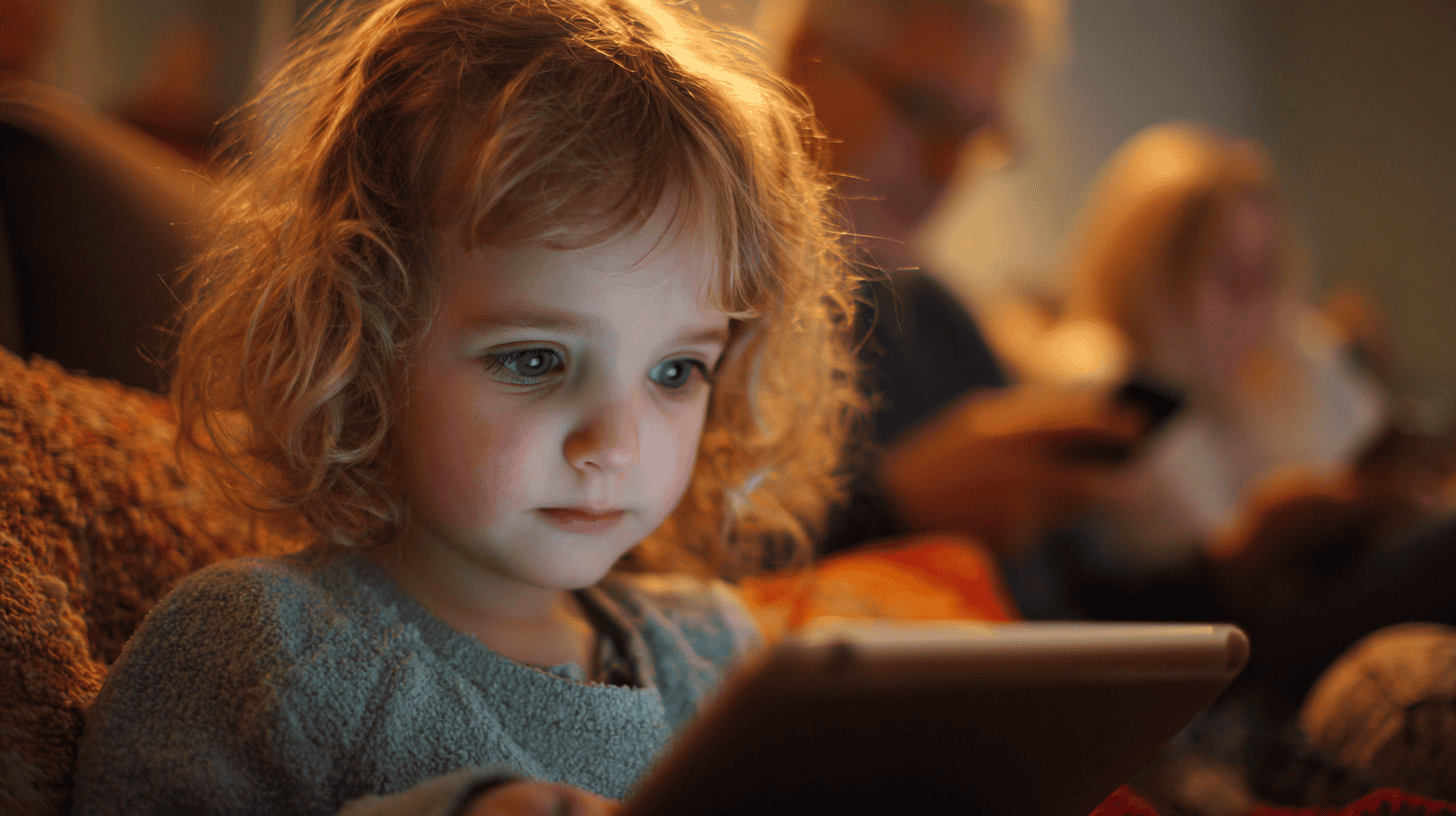
When conversations turn to young children and development, screen time often dominates the discussion. How much is too much? Are screens damaging language development? Should parents be stricter?
New findings from the Children of the 2020s: home learning environment and screen time at age 2 study suggest a more nuanced and more hopeful picture. Screen time matters, but it is far from the strongest influence on early learning. What seems to matter more are the everyday interactions children experience at home, and the wider circumstances families are navigating.
A national snapshot of life at age 2
Children of the 2020s (COT20s) is a large, nationally representative birth cohort study following children born in England in the early 2020s. This research brief draws on data collected when children were around two years old, based on reports from their primary caregivers.
As with all observational research, the findings describe patterns and associations, not direct cause-and-effect relationships. That caveat matters, but the patterns themselves are striking and consistent with earlier UK and international research.
Home learning: small moments, big differences
One of the clearest findings concerns the home learning environment. The study looked at how often children experienced simple activities such as:
-
being read to or looking at books
-
singing songs or nursery rhymes
-
counting or playing with numbers
-
drawing or painting.
Children who experienced these activities more frequently and more consistently had substantially larger spoken vocabularies at age two.
The size of this association is important. Differences linked to the richness of the home learning environment were larger than differences linked to income or screen time. In other words, everyday interactions appear to be one of the strongest correlates of early language development.
This reinforces a long-standing message from developmental science: young children learn language through responsive, back-and-forth interaction, not through passive exposure.
Screen time: common, unequal, and context-dependent
Screen use among two-year-olds is now almost universal. In this study, 98% of children used screens daily, with an average of just over two hours per day, well above the World Health Organization’s (WHO) guideline of no more than one hour for children aged 2-4.
Higher levels of screen time were associated with:
-
smaller spoken vocabularies
-
a higher likelihood of emotional and behavioural difficulties
However, these associations were weaker than those seen for home learning activities, and they were not linear. The strongest links appeared at the very highest levels of screen use.
Crucially, screen time was not randomly distributed. Children had higher screen exposure when families were facing economic hardship, lower parental education, or poorer parental mental health.
This matters for how we interpret the findings. Screen use often reflects the realities of family life, time pressure, stress, lack of affordable childcare, and the need for moments of calm, rather than a lack of parental care or concern.
Parental mental health: an indirect but important role
One particularly interesting finding challenges some common assumptions. Parental depression and anxiety were not associated with how often parents engaged in home learning activities such as reading or singing.
Parents experiencing mental health difficulties were just as likely to provide learning interactions.
Where mental health did matter was elsewhere:
-
children of parents with depression or anxiety had higher screen time
-
they were more likely to show signs of emotional or behavioural difficulties
This suggests that supporting parental wellbeing may influence children’s development indirectly, by shaping the wider home environment and daily routines, rather than by reducing parents’ motivation to engage.
Inequality is already visible, long before school
Perhaps the most sobering finding is how early inequalities appear. By age two, clear differences were already visible in:
-
vocabulary
-
emotional and behavioural wellbeing
-
access to home learning opportunities
-
exposure to screen time
These differences followed familiar socio-economic patterns, closely linked to income, education and family circumstances.
From an education perspective, this is critical. Schools and early years settings do not create these gaps; they inherit them. By the time children enter formal education, many trajectories are already diverging.
What does this mean for educators?
The findings point towards a shift in emphasis.
Rather than focusing narrowly on reducing screen time, the evidence suggests greater impact may come from:
-
promoting language-rich interactions
-
modelling simple, low-cost activities families can fit into daily routines
-
encouraging shared screen use where screens are present
-
offering guidance that is supportive rather than prescriptive
Importantly, the study also underlines the limits of what educators alone can achieve. Many of the strongest patterns reflect structural disadvantage, not individual choices. Addressing early inequality requires coordinated support across education, health and social policy.
What the evidence does not say
It’s worth being explicit about what this research does not show:
-
It does not prove that screen time causes language delay
-
It does not show that parents with mental health difficulties are less engaged or less caring
-
It does not suggest that banning screens is a silver bullet
What it does show is that early development is shaped by a web of interacting factors, economic conditions, parental wellbeing, daily routines and opportunities for interaction.
A hopeful takeaway
If there is a hopeful message here, it is this: small, everyday interactions matter. Talking, reading, singing and playing are powerful, and they do not require specialist knowledge or expensive resources.
For educators and policymakers alike, the challenge is to create conditions in which more families are supported to provide these experiences, from the very earliest years.
Because by age two, the story of inequality is already being written, but it is not yet fixed.
Read the original DFE report here: Children of the 2020s: home learning environment and screen time at age 2